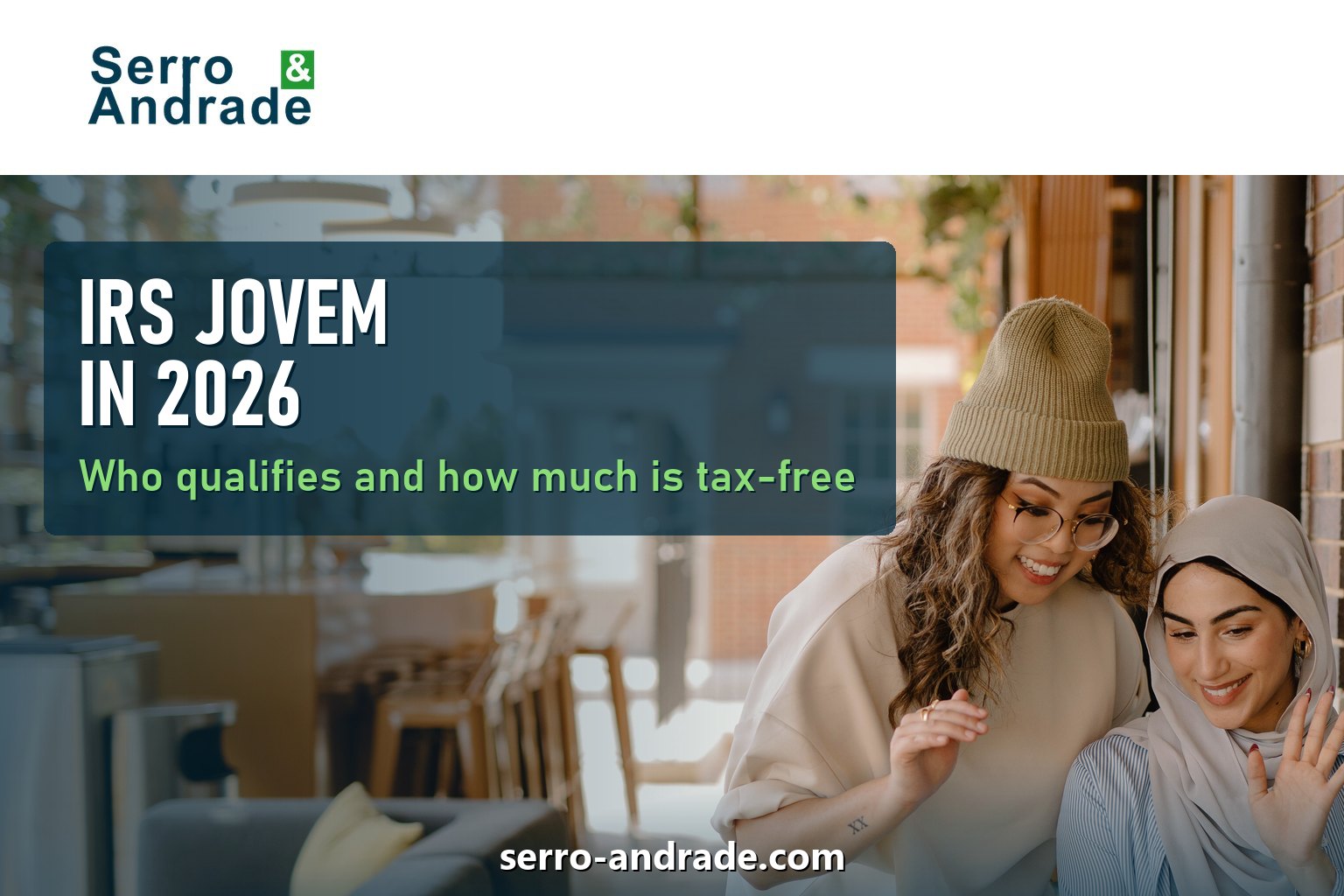
In summary: From 2025, anyone aged 35 or under who is not a dependant will pay less income tax (IRS) on their employment income (categories A and B) during their first 10 years of earning an income: 100% exempt in the 1st year, 75% from the 2nd to the 4th, 50% from the 5th to the 7th and 25% from the 8th to the 10th, up to a limit of 55 times the IAS per year (€29,542.15 in 2026). It is no longer necessary to have completed a course of study.
To find out how much you’ll save in your case, this year and in the years to come, use the Youth Income Tax Simulator.
Who is eligible for the IRS Jovem scheme?
The scheme is set out in Article 12-B of the Personal Income Tax Code, as amended by Law No. 45-A/2024 (State Budget for 2025), and applies equally to income earned in 2025 and 2026. Those who, in the year in which the income was earned:
- has up to 35 years of age on 31 December (anyone turning 36 this year is no longer eligible);
- is not dependent, that is to say, they submit the tax return in their own name and are not included in their parents’ household;
- has income from the employed work (category A) or of self-employment (category B);
- has the tax affairs in order;
- is still within the The first 10 years for generating income.
Taxpayers who benefit or have benefited from the non-habitual resident scheme (RNH) or the tax incentive for scientific research and innovation (IFICI) are excluded, for good, and those who have opted for the ex-resident scheme under Article 12-A (the ‘Regressar’ Programme).
How much of one’s income is tax-free?
| Year in which income was received | Exempt portion |
|---|---|
| Year 1 | 100% |
| Years 2 to 4 | 75% |
| Years 5 to 7 | 50% |
| Years 8 to 10 | 25% |
The exemption is subject to an annual limit of 55 times the IAS: 28 737,50 € in the 2025 income and 29 542,15 € in 2026. The limit applies per taxpayer and is a single limit for categories A and B combined.
One detail that surprises many people is that the tax-free income is taken into account when calculating the income tax rate that applies to the portion that remains taxable (known as ‘aggregation for tax rate purposes’). Therefore, the saving is real, but it is not equal to the tax-free percentage multiplied by the maximum rate.
How to mark the 10th anniversary
- It is said that since the the first year in which he received income from employment in his own name, even if this was before 2025 and even if you have never used the old IRS Jovem scheme. Anyone who started working in 2021, for example, will be in their 6th year (50%) in 2026.
- They don’t count years in which you had no income in categories A or B, years in which you were a dependent of your parents, and years in which you were exempt from filing a tax return. Taking a break postpones the benefit; it does not cause you to lose it.
- Age is the deciding factor: any years left after the age of 35 are lost.
An example
A young person in their first year of earning an income, with a gross salary of €20,000 in 2025, living alone and with no deductions other than general expenses: without the Youth Income Tax Scheme, they would pay around €2,139.73 in income tax; with the Youth Income Tax scheme, the entire income is exempt and no income tax is payable. In subsequent years, the saving decreases in line with the percentage rate, and also depends on salary, household circumstances and deductions. The simulator It calculates the figures for your situation and shows the 10-year forecast.
How to apply for the IRS Jovem
- As part of your salary, every month (optional): If you inform your employer that you are covered by the scheme and which tax year your income falls under, the tax at source will then apply only to the non-exempt portion, and you will receive more each month. All it takes is a simple request, for example by email. If you do not do this, you will receive the difference as a tax refund.
- On your income tax return (this is where it counts): For income from employment, in Annex A, declare your total income (including the tax-free portion) and tick ‘Yes’ in box 4F.1. For income from self-employment, the relevant option is selected in Annex B. The automatic income tax return may already include this scheme, but please check that the option is ticked before submitting.
What has changed regarding the 2024 Youth Income Tax Scheme?
Until 2024, the scheme required applicants to be aged between 18 and 26 (30 for those with a PhD), to have completed a course of study, and lasted for 5 years, with lower percentages and limits. From 2025: age up to 35, no educational requirements, 10 years’ entitlement to benefits and a limit of 55 × IAS. The years of earnings accrued before 2025 count towards the 10 years, but the benefit only applies from 2025 onwards.
Article revised by the technical team at Serro & Andrade in November 2026. Legal basis: Article 12-B of the Personal Income Tax Code (Law No. 45-A/2024), the Tax Authority’s ‘IRS Jovem’ leaflet and Circular No. 20274/2025. For an analysis of your case, get in touch with us.
By António Serro da Fonseca, Certified Accountant